R3 第一轮审计提交
王家卫风格提示词产品 · 整改第 3 轮 · 本轮只审验收顺序的前两关:真人感、光线与摄影可信度 · 产品状态 HOLD
给审阅模型的说明
你就是上一轮下达 R3 整改指令的审阅方。背景复述如下:R2(V2.1 版提示词的出图)被你判不通过——死因不是手指或文字错误,而是两条更基础的问题:(1) 人物第一眼不像真实演员(皮肤平滑、五官规整、神态摆拍);(2) 光线是 AI 制造的电影效果(主体总被均匀照亮,环境光源解释不了这种照明)。你据此定下新的验收顺序:真人感 → 光线与摄影可信度 → 导演风格准确度 → 跨场景稳定性,并要求前两关不过关时不进入风格评分;同时要求制作方重写共用 CORE、冻结经典场景与标志道具、先提交三类镜头(人物近景/双人中景/夜间环境人像)并附生成记录。
制作方已按指令完成 R3 第一轮整改与出图(改动摘要与生成记录见本页)。本页提交 6 张测试图,请你本轮只审前两关:真人感、光线与摄影可信度。请不要进行导演风格评分。
作答要求:请逐图给出三轴裁定(真人感/光线物理/成像,各给 过/部分/不过,并给出具体画面依据);制作方已在本页附上自己的逐图自检结论,与你的判断不一致处请直接指出;最后请回答本页末尾的 Q1–Q4,并给出总闸口结论。
R3 改动摘要
- CORE 新增真人段(审阅方原文):普通可信的真人演员、面部自然不对称、克制的表情与可信的身体姿态、皮肤质感随场景实际光源变化、未经精修的真实演员抽帧——而非数码完美化的脸。
- CORE 新增光线物理段(审阅方原文):每个高光与阴影必须能溯源到画面内一个可信的物理光源;动机性实景光源+距离衰减+可信的阴影方向;各光源保留自身色温;禁止无形正面补光;面部阴影可以保持欠曝;明暗与颜色由照明环境决定,不由全局电影染色罩出来。
- CORE 新增成像段(审阅方原文):焦点面跟随叙事主体、景深自然衰减;颗粒随曝光与暗部密度变化;光晕只出现在强的实景高光处;明名数码清晰度增强、HDR 影调映射、人工微反差、美容磨皮为须避免的缺陷。
- 三模式的光色改为由光源推导,并各加一条「钉死句」:模式 A——一切色差来自画面内混合光源各自的位置与色温,不得全图罩色;模式 B——绿色在空间内、乃至在同一张脸上都不均匀(额头与鼻梁受光、眼窝与下颌入影,按与灯管的距离和角度受光);模式 C——一至两个暖色实景光源干全部的活、衰减柔和、人物部分干脆留在阴影里,不补光、不解释。
- 冻结项:经典场景(S1–S7 签名预设)与标志道具优化本轮冻结未动,预设内嵌的仍是 V2.1 版 CORE;DETAIL SAFETY 章节与变量表未动。待真人感与光线两关通过后再解冻换基。
- 产品状态:HOLD,不发布「已修复」结论。
生成记录(统一说明)
- 6 张图全部为纯文本生成,未使用任何参考图,未做任何后期编辑(模型直出)。
- 生成工具为 Muse 媒体生成管线(media.generate_image);该工具回执不披露底层图像模型型号,记录只能如实写到管线层级,不虚构型号。
- 每张图的完整提示词由 R3 版 CORE(真人段+光线物理段+成像段全带)+对应模式块原文组装,全文附在各自图下(可折叠展开),未做删节。
- 过程如实记录:图 C2 第一次提交时提示词曾被截断(缺成像段尾与整个模式 C 块),该废稿已删除,本页 C2 为完整提示词重生成的版本,图下附的即完整全文。
6 张测试图与制作方自检
类一 · 人物近景(模式 B)
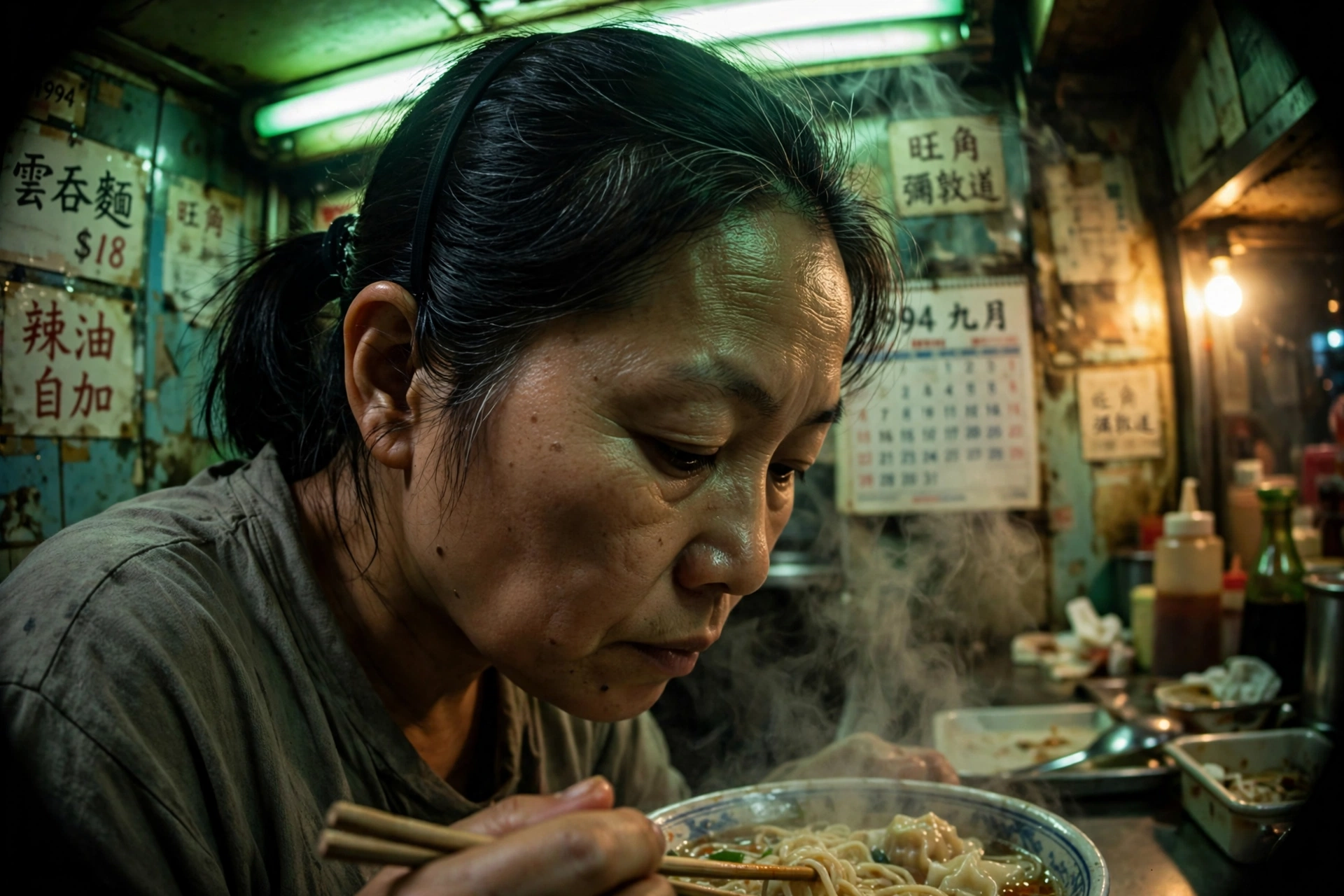
图 B2 · 面店吃面女子
真人感合格(中年女性、白发、斑点、低头吃面,非摆拍);光线合格(头顶荧光绿、面部有衰减、右后暖光为残余暖色);成像轻微超锐(额头皮肤细节略过清)但可接受。综合:合格,本类最佳。
本图完整提示词(点击展开)
A candid frame from a 35mm narrative motion picture showing an ordinary Asian woman in her forties with her hair tied back plainly, eating noodles from a bowl and looking down at it, wisps of steam rising past her face, close-up on her face and shoulders, inside a cramped late-night noodle shop lit by green fluorescent tubes, Hong Kong, 1994. The camera captures an unposed moment within an ongoing scene, from a physically plausible camera position. Lived-in environmental details. The image should feel like a frame extracted from a film, not a promotional portrait, fashion editorial, or carefully arranged photographic set. The subject is a believable, ordinary human actor captured during an unposed moment. Natural facial proportions with subtle asymmetry, individual facial structure, understated expressions and physically plausible body posture. Skin texture varies naturally across the face, with subtle imperfections and realistic tonal transitions under the actual scene lighting. The subject is not posing for a portrait. Facial features, hair and clothing must respond consistently to the same physical light sources. The result must resemble an unretouched frame of a real actor photographed on a motion-picture camera, rather than a digitally perfected face. Every visible highlight and shadow must be consistent with a plausible physical light source within the scene. Use motivated practical lighting with natural distance falloff, believable shadow direction and realistic variation in illumination. Different light sources retain their distinct color temperatures and affect nearby surfaces according to their position and intensity. The subject is not artificially brightened by an invisible frontal fill light. Facial shadows may remain underexposed. Brightness and color are determined by the actual lighting environment, not by a global cinematic color overlay. Preserve natural highlight transitions and the imperfect exposure characteristics of a photographed scene. Natural 35mm motion-picture optical rendering. The plane of focus follows the narrative subject, with physically plausible depth-of-field falloff. Fine detail is preserved near the focal plane and gradually softens away from it. Moderate, irregular photochemical grain varies with exposure and shadow density. Subtle optical halation is limited to strong practical highlights. Avoid the appearance of digital clarity enhancement, HDR tone mapping, artificial microcontrast and cosmetic skin retouching. A cramped Hong Kong urban interior dominated by green fluorescent lighting. An extremely short focal-length lens observes the subject from within arm's reach, creating strong but physically coherent perspective distortion. The near face appears enlarged by optical perspective, while eyes, ears, jaw and hands remain anatomically consistent. Green fluorescent light contaminates skin, walls and shadows at different intensities, with small traces of residual warm color. Bright practical tubes produce irregular optical bloom, while deep green-black recesses retain limited environmental detail. The camera feels intrusive, unstable and close, with imperfect framing and cropped foreground objects. The green is never uniform: it is distributed unevenly through the space and across a single face — forehead and nose bridge catch the tube light while eye sockets and jaw fall away into shadow — each surface lit according to its distance and angle to the actual tubes. An uncomfortably close camera position turns ordinary architectural depth into exaggerated optical perspective. Fluorescent light alters the colors of different surfaces unevenly, while imperfect framing and physical proximity create restless visual tension.
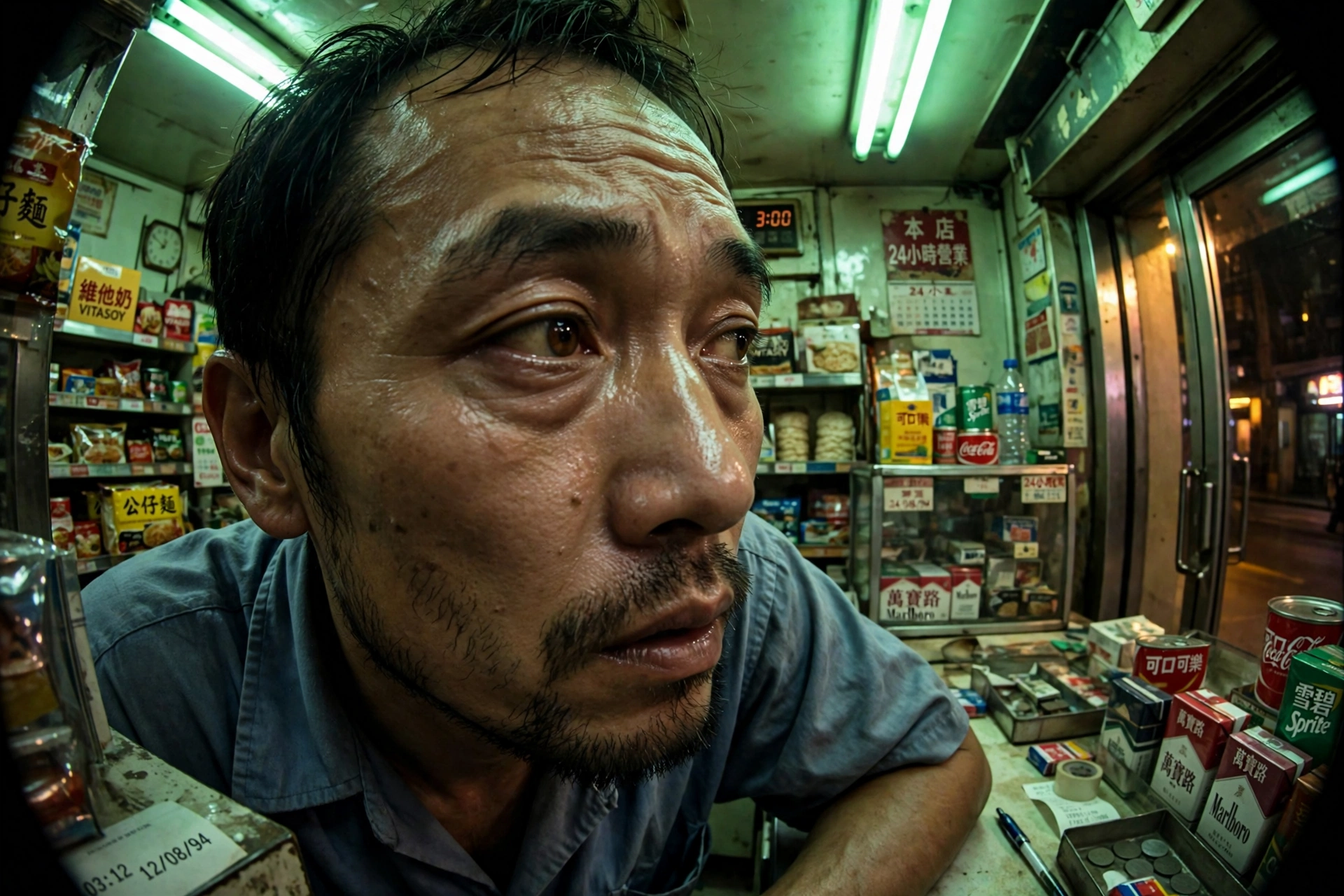
图 B1 · 便利店夜班店员
真人感基本合格(胡茬/眼袋/侧目不摆拍;额头与鼻梁油光略过重);光线部分合格(灯管与门口暖光可指认、脸有明暗分区,但脸部整体仍偏亮、远侧脸颊衰减不足);成像不合格倾向(背景货架全场清晰、细节密度与微反差仍带数码味)。综合:部分合格,未全过。
本图完整提示词(点击展开)
A candid frame from a 35mm narrative motion picture showing a tired night-shift convenience store clerk in his late thirties, an ordinary Asian man with an unshaven jaw, leaning his weight on the counter and glancing sideways toward the shop door, close-up on his face and shoulders, inside the green fluorescent-lit interior of a small convenience store at 3 a.m., Hong Kong, 1994. The camera captures an unposed moment within an ongoing scene, from a physically plausible camera position. Lived-in environmental details. The image should feel like a frame extracted from a film, not a promotional portrait, fashion editorial, or carefully arranged photographic set. The subject is a believable, ordinary human actor captured during an unposed moment. Natural facial proportions with subtle asymmetry, individual facial structure, understated expressions and physically plausible body posture. Skin texture varies naturally across the face, with subtle imperfections and realistic tonal transitions under the actual scene lighting. The subject is not posing for a portrait. Facial features, hair and clothing must respond consistently to the same physical light sources. The result must resemble an unretouched frame of a real actor photographed on a motion-picture camera, rather than a digitally perfected face. Every visible highlight and shadow must be consistent with a plausible physical light source within the scene. Use motivated practical lighting with natural distance falloff, believable shadow direction and realistic variation in illumination. Different light sources retain their distinct color temperatures and affect nearby surfaces according to their position and intensity. The subject is not artificially brightened by an invisible frontal fill light. Facial shadows may remain underexposed. Brightness and color are determined by the actual lighting environment, not by a global cinematic color overlay. Preserve natural highlight transitions and the imperfect exposure characteristics of a photographed scene. Natural 35mm motion-picture optical rendering. The plane of focus follows the narrative subject, with physically plausible depth-of-field falloff. Fine detail is preserved near the focal plane and gradually softens away from it. Moderate, irregular photochemical grain varies with exposure and shadow density. Subtle optical halation is limited to strong practical highlights. Avoid the appearance of digital clarity enhancement, HDR tone mapping, artificial microcontrast and cosmetic skin retouching. A cramped Hong Kong urban interior dominated by green fluorescent lighting. An extremely short focal-length lens observes the subject from within arm's reach, creating strong but physically coherent perspective distortion. The near face appears enlarged by optical perspective, while eyes, ears, jaw and hands remain anatomically consistent. Green fluorescent light contaminates skin, walls and shadows at different intensities, with small traces of residual warm color. Bright practical tubes produce irregular optical bloom, while deep green-black recesses retain limited environmental detail. The camera feels intrusive, unstable and close, with imperfect framing and cropped foreground objects. The green is never uniform: it is distributed unevenly through the space and across a single face — forehead and nose bridge catch the tube light while eye sockets and jaw fall away into shadow — each surface lit according to its distance and angle to the actual tubes. An uncomfortably close camera position turns ordinary architectural depth into exaggerated optical perspective. Fluorescent light alters the colors of different surfaces unevenly, while imperfect framing and physical proximity create restless visual tension.
类二 · 双人中景(模式 C)
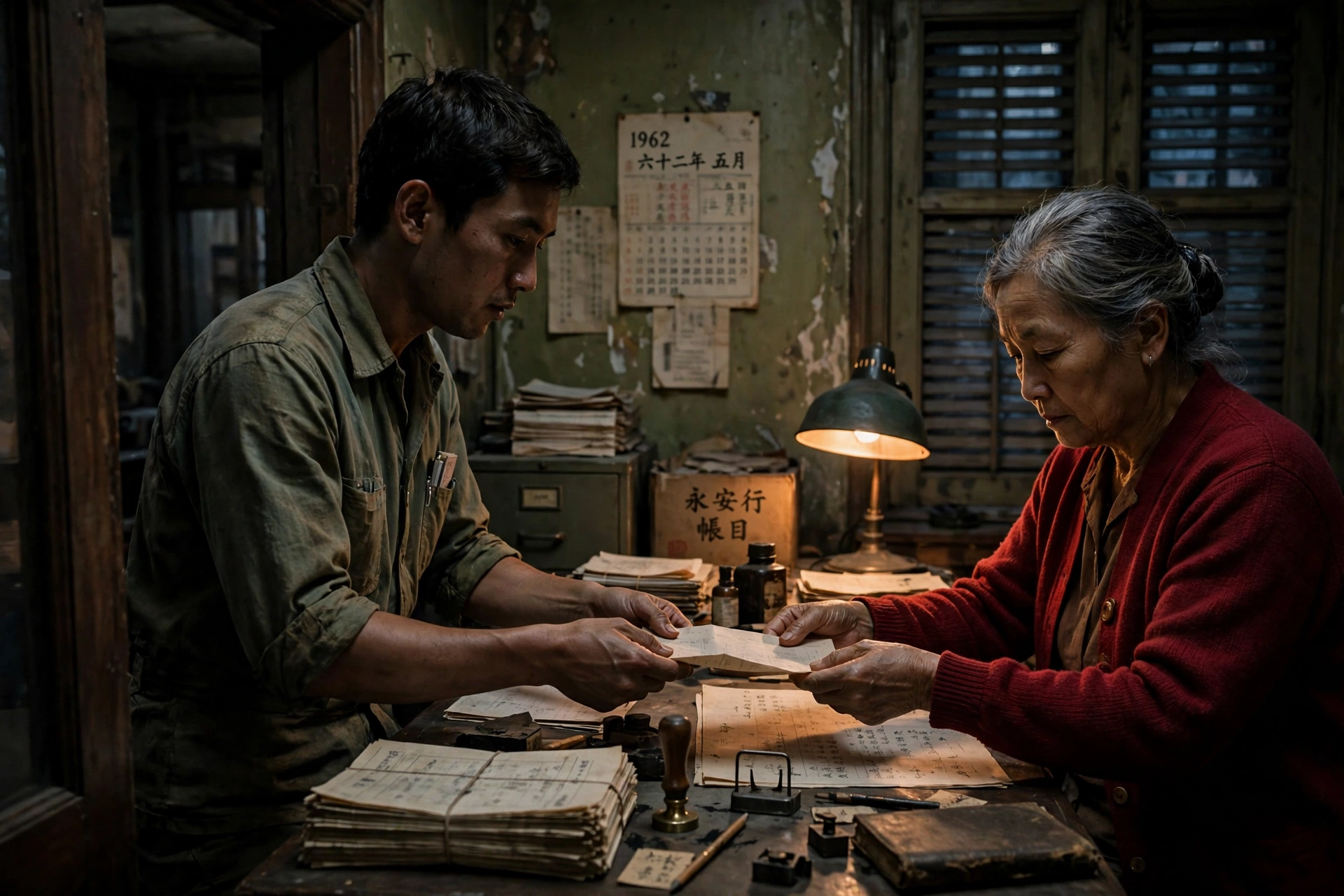
图 C2 · 办公室递文件
真人感合格(老妇灰发与老手握文件最可信、文员侧脸普通自然、双手交接无结构错误);光线合格(台灯为明确主源、在两人之间、百叶窗冷光在后、色温分区有位置依据);成像合格(焦点在桌面文件、背景自然变软)。综合:合格,本轮双人类最佳。
本图完整提示词(点击展开)
A candid frame from a 35mm narrative motion picture showing a young office clerk handing a paper document across a desk to an older woman, both pairs of hands visible at the desk surface, medium shot, in a small Hong Kong office lit by one shaded desk lamp and a shuttered window, Hong Kong, 1962. The camera captures an unposed moment within an ongoing scene, from a physically plausible camera position. Lived-in environmental details. The image should feel like a frame extracted from a film, not a promotional portrait, fashion editorial, or carefully arranged photographic set. The subject is a believable, ordinary human actor captured during an unposed moment. Natural facial proportions with subtle asymmetry, individual facial structure, understated expressions and physically plausible body posture. Skin texture varies naturally across the face, with subtle imperfections and realistic tonal transitions under the actual scene lighting. The subject is not posing for a portrait. Facial features, hair and clothing must respond consistently to the same physical light sources. The result must resemble an unretouched frame of a real actor photographed on a motion-picture camera, rather than a digitally perfected face. Every visible highlight and shadow must be consistent with a plausible physical light source within the scene. Use motivated practical lighting with natural distance falloff, believable shadow direction and realistic variation in illumination. Different light sources retain their distinct color temperatures and affect nearby surfaces according to their position and intensity. The subject is not artificially brightened by an invisible frontal fill light. Facial shadows may remain underexposed. Brightness and color are determined by the actual lighting environment, not by a global cinematic color overlay. Preserve natural highlight transitions and the imperfect exposure characteristics of a photographed scene. Natural 35mm motion-picture optical rendering. The plane of focus follows the narrative subject, with physically plausible depth-of-field falloff. Fine detail is preserved near the focal plane and gradually softens away from it. Moderate, irregular photochemical grain varies with exposure and shadow density. Subtle optical halation is limited to strong practical highlights. Avoid the appearance of digital clarity enhancement, HDR tone mapping, artificial microcontrast and cosmetic skin retouching. Hong Kong, 1962. A quiet, restrained composition illuminated by a plausible warm practical light source appropriate to the actual location. Deep crimson, olive green, amber and brown exist as distinct colors of fabrics, painted walls and aged architectural surfaces. Warm light falls naturally across faces, with gradual transitions into deep shadow. A longer lens observes the scene from a slightly removed position. A doorway, wall edge or nearby object may partially obstruct the composition when physically appropriate. Human gestures remain small and restrained. The emotional distance between characters is expressed through their positions, empty space and avoided eye contact. Natural optical softness, subtle grain, restrained highlights and quiet atmosphere. One or two warm practical sources do all the work: their light decays softly with distance, and parts of each figure are simply left in shadow — unlit, unfilled, unexplained. Architectural layers separate characters even when they occupy the same room. Warm practical light reveals only fragments of their gestures, leaving emotional tension in the empty space and the parts of the scene outside the camera's view.
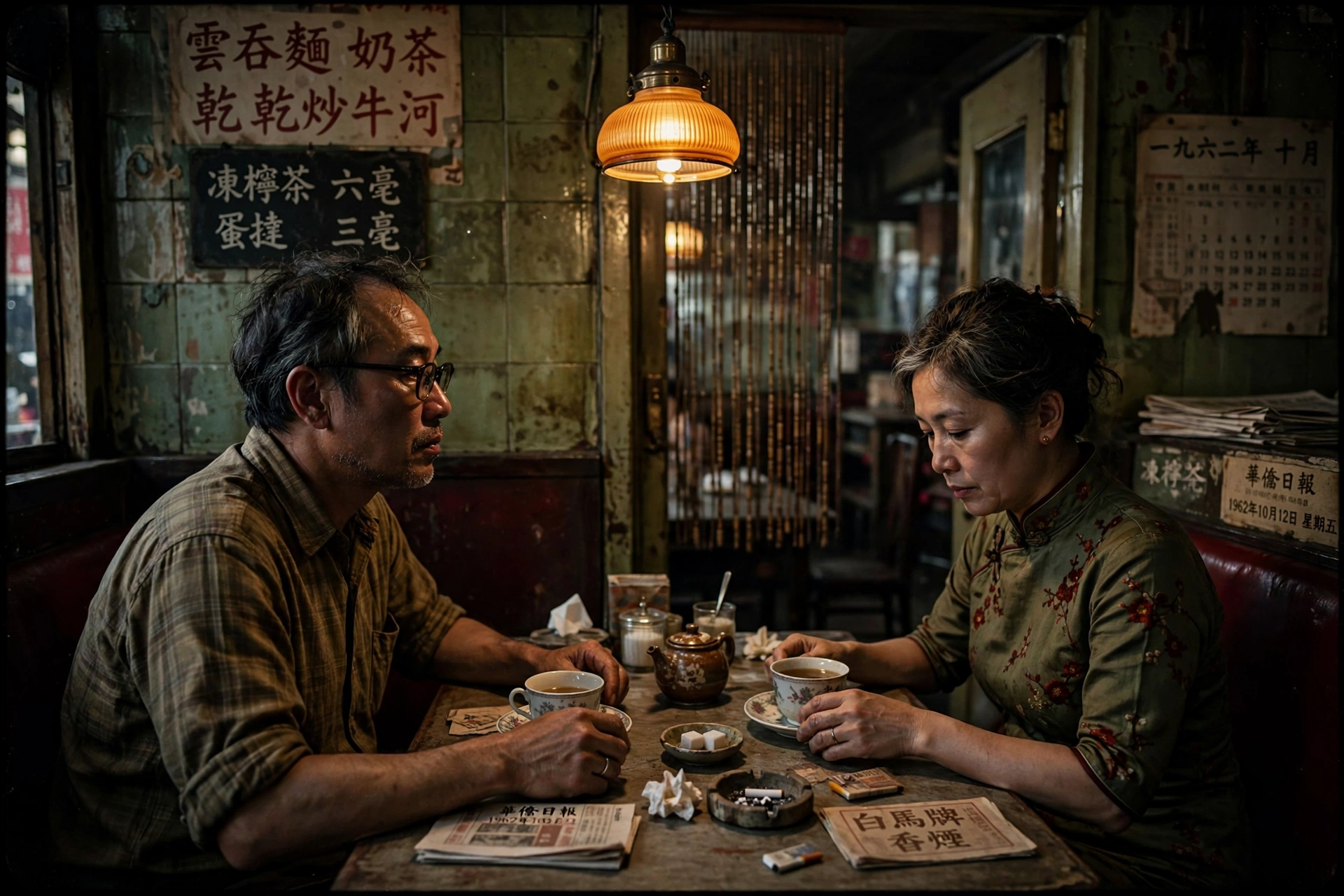
图 C1 · 茶餐厅卡座夫妇
真人感合格(两人均为普通中年人、表情克制、手部自然、互不对镜);光线合格(罩灯为可指认单一暖源、向边缘衰减、背景卡座入暗);成像轻微偏「信息全清」(招牌/日历/报纸全可读,布景感略强,但在年代剧可接受范围)。综合:合格。
本图完整提示词(点击展开)
A candid frame from a 35mm narrative motion picture showing a middle-aged married couple in 1960s Hong Kong dress sitting opposite each other in a tea restaurant booth, speaking quietly, both pairs of hands resting on the table around porcelain teacups, medium shot, in a Hong Kong tea restaurant booth under a shaded hanging lamp, Hong Kong, 1962. The camera captures an unposed moment within an ongoing scene, from a physically plausible camera position. Lived-in environmental details. The image should feel like a frame extracted from a film, not a promotional portrait, fashion editorial, or carefully arranged photographic set. The subject is a believable, ordinary human actor captured during an unposed moment. Natural facial proportions with subtle asymmetry, individual facial structure, understated expressions and physically plausible body posture. Skin texture varies naturally across the face, with subtle imperfections and realistic tonal transitions under the actual scene lighting. The subject is not posing for a portrait. Facial features, hair and clothing must respond consistently to the same physical light sources. The result must resemble an unretouched frame of a real actor photographed on a motion-picture camera, rather than a digitally perfected face. Every visible highlight and shadow must be consistent with a plausible physical light source within the scene. Use motivated practical lighting with natural distance falloff, believable shadow direction and realistic variation in illumination. Different light sources retain their distinct color temperatures and affect nearby surfaces according to their position and intensity. The subject is not artificially brightened by an invisible frontal fill light. Facial shadows may remain underexposed. Brightness and color are determined by the actual lighting environment, not by a global cinematic color overlay. Preserve natural highlight transitions and the imperfect exposure characteristics of a photographed scene. Natural 35mm motion-picture optical rendering. The plane of focus follows the narrative subject, with physically plausible depth-of-field falloff. Fine detail is preserved near the focal plane and gradually softens away from it. Moderate, irregular photochemical grain varies with exposure and shadow density. Subtle optical halation is limited to strong practical highlights. Avoid the appearance of digital clarity enhancement, HDR tone mapping, artificial microcontrast and cosmetic skin retouching. Hong Kong, 1962. A quiet, restrained composition illuminated by a plausible warm practical light source appropriate to the actual location. Deep crimson, olive green, amber and brown exist as distinct colors of fabrics, painted walls and aged architectural surfaces. Warm light falls naturally across faces, with gradual transitions into deep shadow. A longer lens observes the scene from a slightly removed position. A doorway, wall edge or nearby object may partially obstruct the composition when physically appropriate. Human gestures remain small and restrained. The emotional distance between characters is expressed through their positions, empty space and avoided eye contact. Natural optical softness, subtle grain, restrained highlights and quiet atmosphere. One or two warm practical sources do all the work: their light decays softly with distance, and parts of each figure are simply left in shadow — unlit, unfilled, unexplained. Architectural layers separate characters even when they occupy the same room. Warm practical light reveals only fragments of their gestures, leaving emotional tension in the empty space and the parts of the scene outside the camera's view.
类三 · 夜间环境人像(模式 A)
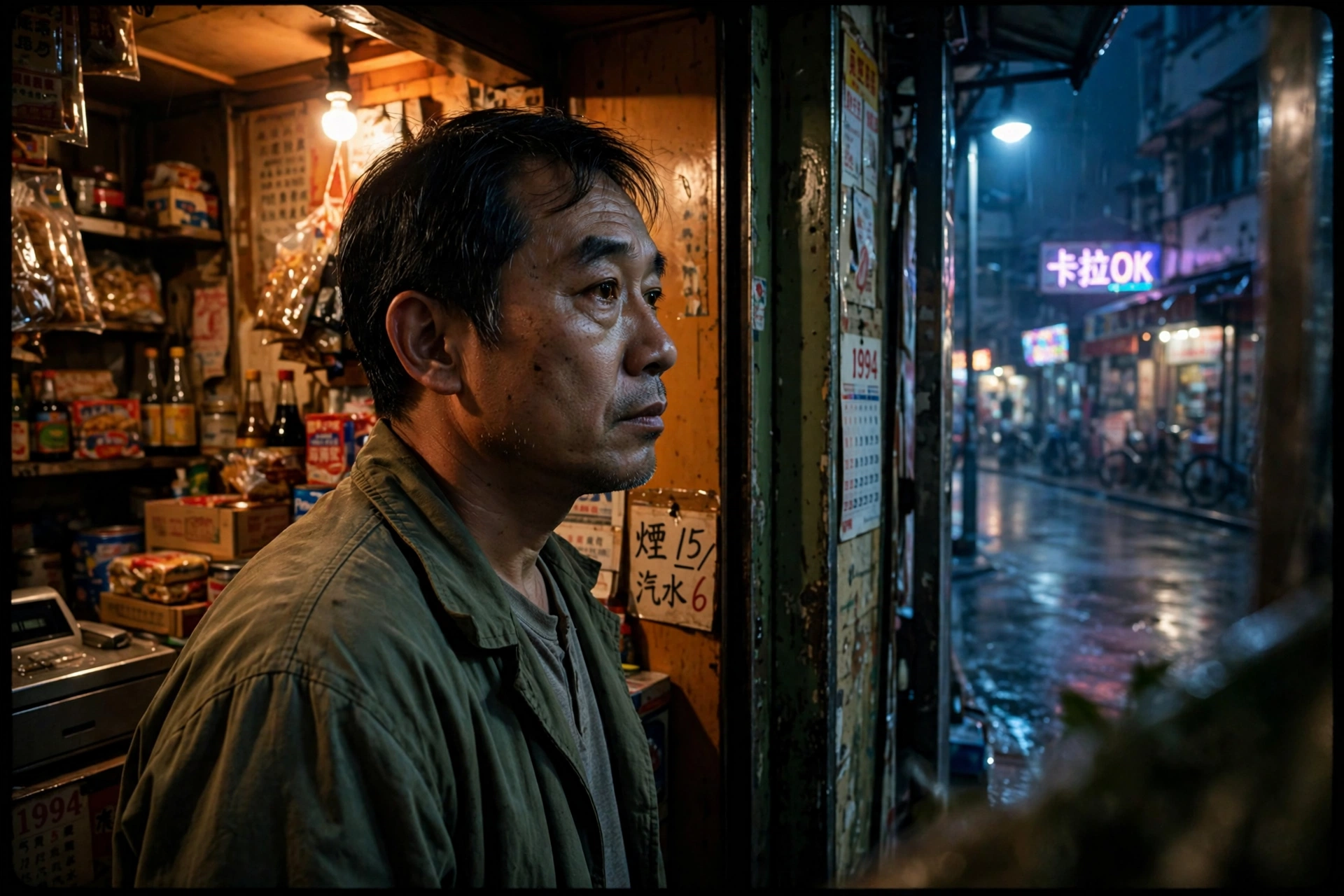
图 A1 · 小店门口男子
真人感合格(中年男子侧脸、皮肤斑驳、目光向街、不摆拍);光线合格(店内钨丝暖光在左后、街灯与卡拉 OK 招牌冷光在右远,三源各有其位、脸部近街一侧真实欠曝);成像基本合格(街道背景衰减自然、仅中景海报略清)。综合:合格,多光源分区为本轮最清楚一张。
本图完整提示词(点击展开)
A candid frame from a 35mm narrative motion picture showing an ordinary Asian man in his forties standing in the doorway of a small street shop at night, half turned toward the street, medium shot — warm tungsten light inside the shop behind him, a cool street lamp reaching him from the side, and the faint colored glow of a distant sign far down the street, Hong Kong, 1994. The camera captures an unposed moment within an ongoing scene, from a physically plausible camera position. Lived-in environmental details. The image should feel like a frame extracted from a film, not a promotional portrait, fashion editorial, or carefully arranged photographic set. The subject is a believable, ordinary human actor captured during an unposed moment. Natural facial proportions with subtle asymmetry, individual facial structure, understated expressions and physically plausible body posture. Skin texture varies naturally across the face, with subtle imperfections and realistic tonal transitions under the actual scene lighting. The subject is not posing for a portrait. Facial features, hair and clothing must respond consistently to the same physical light sources. The result must resemble an unretouched frame of a real actor photographed on a motion-picture camera, rather than a digitally perfected face. Every visible highlight and shadow must be consistent with a plausible physical light source within the scene. Use motivated practical lighting with natural distance falloff, believable shadow direction and realistic variation in illumination. Different light sources retain their distinct color temperatures and affect nearby surfaces according to their position and intensity. The subject is not artificially brightened by an invisible frontal fill light. Facial shadows may remain underexposed. Brightness and color are determined by the actual lighting environment, not by a global cinematic color overlay. Preserve natural highlight transitions and the imperfect exposure characteristics of a photographed scene. Natural 35mm motion-picture optical rendering. The plane of focus follows the narrative subject, with physically plausible depth-of-field falloff. Fine detail is preserved near the focal plane and gradually softens away from it. Moderate, irregular photochemical grain varies with exposure and shadow density. Subtle optical halation is limited to strong practical highlights. Avoid the appearance of digital clarity enhancement, HDR tone mapping, artificial microcontrast and cosmetic skin retouching. Warm tungsten practical lamps create uneven pools of amber light across a cramped late-night interior. Faces, walls and background objects occupy different zones of warm amber, muted neutral color and deep brown-black shadow, rather than a uniform orange wash. Shadow detail falls off naturally into darkness. Small reflections appear on worn glass and metal. The camera observes the subject from a slightly removed position, with incidental foreground obstructions and an asymmetrical composition. The subject is absorbed in a private moment, unaware of the camera. Every color difference in the frame is produced by the scene's own mixed light sources — tungsten practicals, street light, a distant sign — each acting at its real position and color temperature, never by a wash laid over the whole image. The emotional focus comes from the unequal distribution of warm practical light, deep environmental shadow, and the subject's isolation within a busy but indifferent surrounding space. The camera records a fleeting private moment rather than arranging the scene around recognizable props.
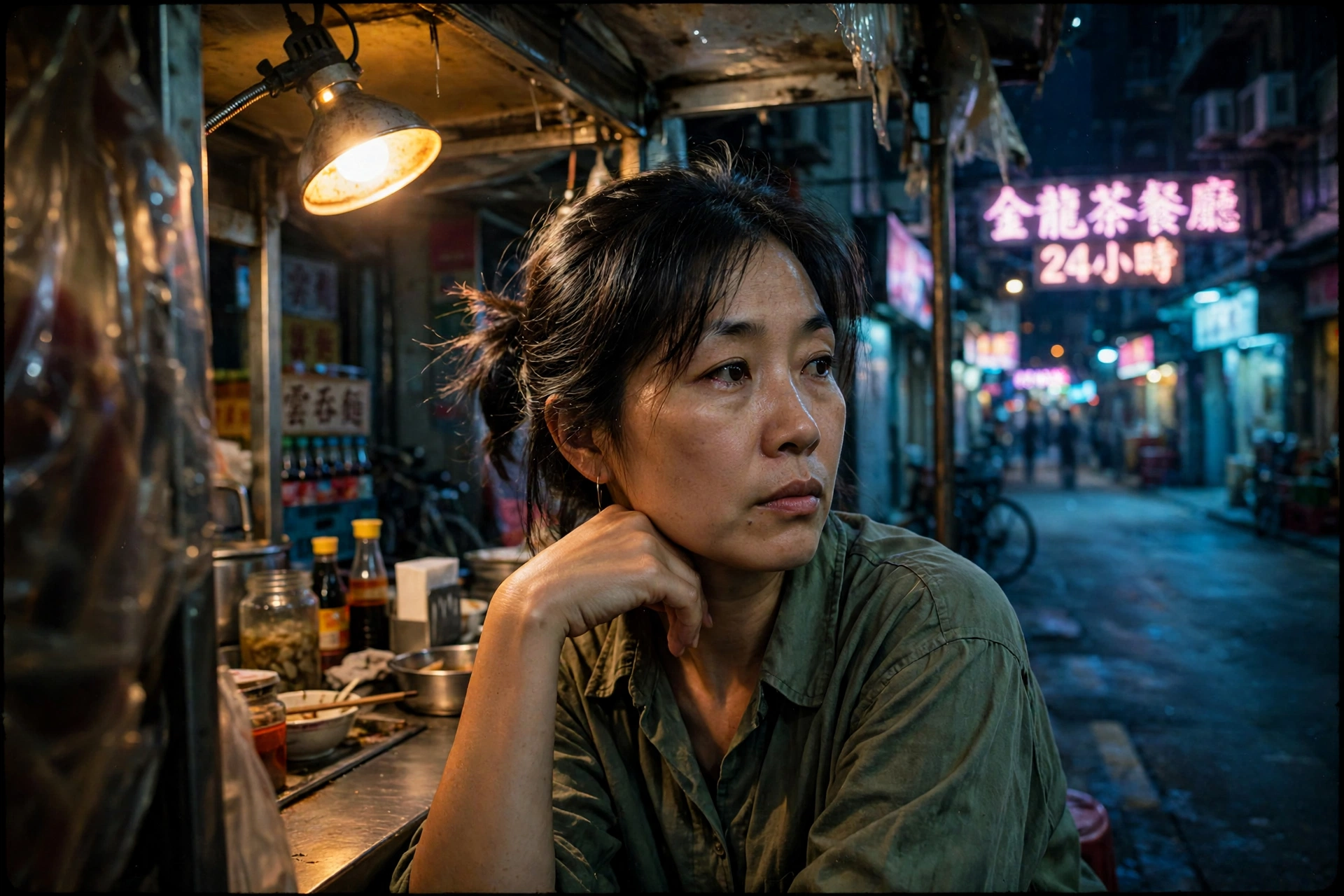
图 A2 · 大排档托腮女子
真人感不合格(托腮远望属经典摆拍姿势、面部皮肤为六张中最平滑规整、像 AI 模特肖像);光线不合格倾向(摊位工作灯在左上后方,但脸部被均匀正面提亮,该亮度无法由画面内任何光源解释,正中「无形正面补光」的死因);成像轻微微反差。综合:不合格。
本图完整提示词(点击展开)
A candid frame from a 35mm narrative motion picture showing an ordinary Asian woman in her thirties sitting at the counter of an open-air street food stall at night, waiting, her chin resting near her hand, medium shot — a tungsten work lamp over the stall, cool light from the street behind her, and a distant neon sign glowing far down the road, Hong Kong, 1994. The camera captures an unposed moment within an ongoing scene, from a physically plausible camera position. Lived-in environmental details. The image should feel like a frame extracted from a film, not a promotional portrait, fashion editorial, or carefully arranged photographic set. The subject is a believable, ordinary human actor captured during an unposed moment. Natural facial proportions with subtle asymmetry, individual facial structure, understated expressions and physically plausible body posture. Skin texture varies naturally across the face, with subtle imperfections and realistic tonal transitions under the actual scene lighting. The subject is not posing for a portrait. Facial features, hair and clothing must respond consistently to the same physical light sources. The result must resemble an unretouched frame of a real actor photographed on a motion-picture camera, rather than a digitally perfected face. Every visible highlight and shadow must be consistent with a plausible physical light source within the scene. Use motivated practical lighting with natural distance falloff, believable shadow direction and realistic variation in illumination. Different light sources retain their distinct color temperatures and affect nearby surfaces according to their position and intensity. The subject is not artificially brightened by an invisible frontal fill light. Facial shadows may remain underexposed. Brightness and color are determined by the actual lighting environment, not by a global cinematic color overlay. Preserve natural highlight transitions and the imperfect exposure characteristics of a photographed scene. Natural 35mm motion-picture optical rendering. The plane of focus follows the narrative subject, with physically plausible depth-of-field falloff. Fine detail is preserved near the focal plane and gradually softens away from it. Moderate, irregular photochemical grain varies with exposure and shadow density. Subtle optical halation is limited to strong practical highlights. Avoid the appearance of digital clarity enhancement, HDR tone mapping, artificial microcontrast and cosmetic skin retouching. Warm tungsten practical lamps create uneven pools of amber light across a cramped late-night interior. Faces, walls and background objects occupy different zones of warm amber, muted neutral color and deep brown-black shadow, rather than a uniform orange wash. Shadow detail falls off naturally into darkness. Small reflections appear on worn glass and metal. The camera observes the subject from a slightly removed position, with incidental foreground obstructions and an asymmetrical composition. The subject is absorbed in a private moment, unaware of the camera. Every color difference in the frame is produced by the scene's own mixed light sources — tungsten practicals, street light, a distant sign — each acting at its real position and color temperature, never by a wash laid over the whole image. The emotional focus comes from the unequal distribution of warm practical light, deep environmental shadow, and the subject's isolation within a busy but indifferent surrounding space. The camera records a fleeting private moment rather than arranging the scene around recognizable props.
请审计的问题
Q1 逐图三轴裁定:请对 6 张图逐张给出真人感/光线物理/成像三轴裁定(各给 过/部分/不过+具体画面依据)。与制作方自检结论不一致处,请逐处指出并说明你的依据。
Q2 CORE 三段新规的兑现度:真人段、光线物理段、成像段这三段新规,在这 6 张出图里是否真的兑现了?哪一段兑现最差?请给出图内证据。
Q3 系统性残留的诊断:制作方归纳的两个系统性残留(① 背景过清、微反差数码味;② 肖像式姿势引力)是否成立?下一步整改应走提示词层还是流程层(如分阶段生成/编辑流程)?
Q4 总闸口结论:按验收顺序,第一关(真人感)与第二关(光线与摄影可信度)是否通过?若不通过,还差什么、下一轮应提交什么,本轮的 4 过/1 部分/1 不过是否足以放行?请给出明确结论,不要进行导演风格评分。